




Title Page
విజ్ఞాన శాస్త్ర సాంకేతిక పరిశోధనా సంస్థ / विज्ञान शास्त्र प्रौद्योगिकी और परिशोधन संगठन
Events
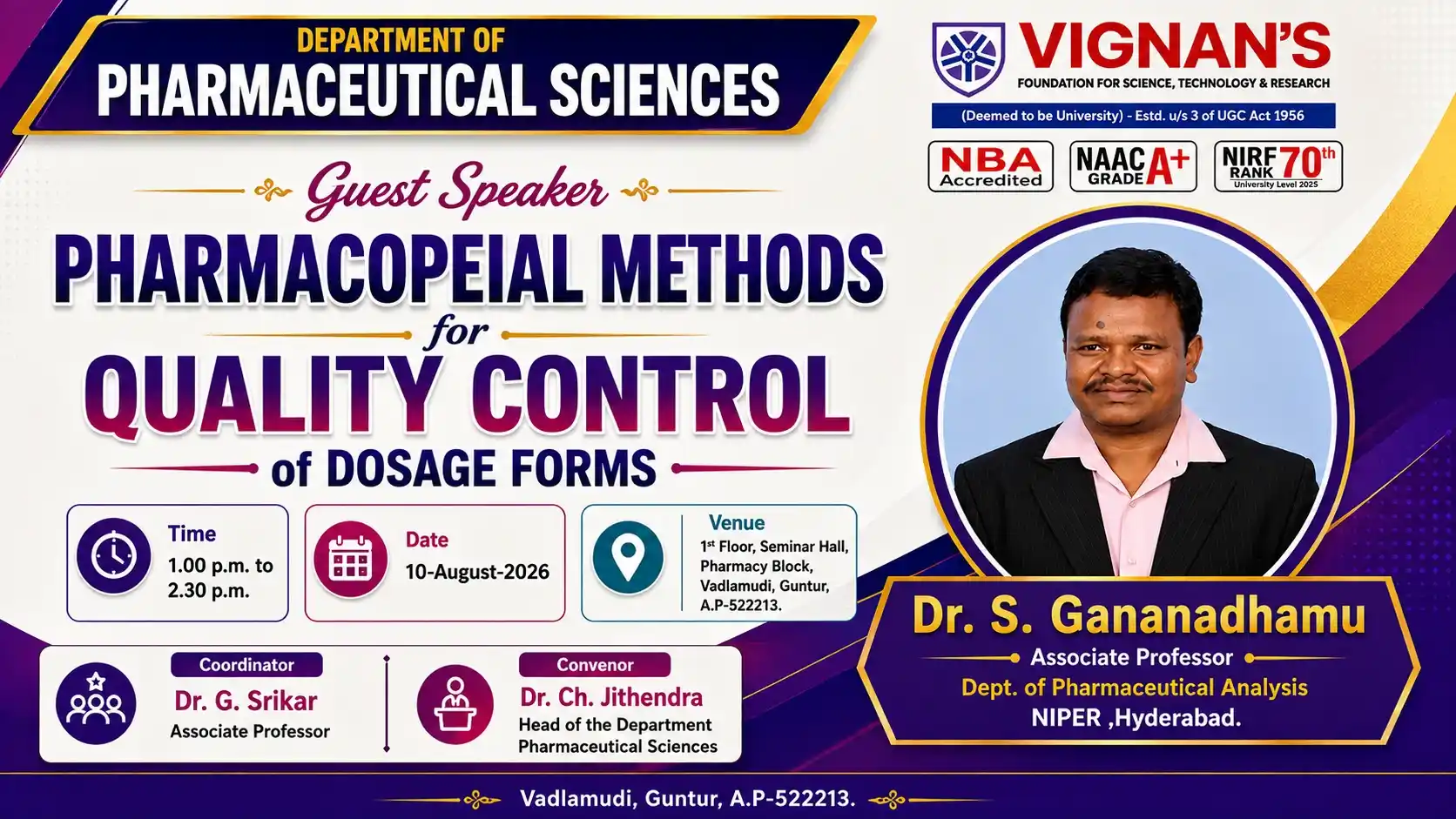
Guest Lecture
Pharmacopeial Methods for Quality Control of Dosage Forms
Aug
10
Monday
01:00
PM
- 02:30
PM
Summary
I. Introduction Quality control is an essential component of pharmaceutical manufacturing. Every pharmaceutical dosage form must meet predefined standards of identity, strength, purity, quality, safety, and consistency before it can be released for use. Pharmacopeias provide scientifically established analytical procedures and acceptance criteria that are used to assess whether pharmaceutical substances and dosage forms comply with specified quality requirements. Therefore, knowledge of pharmacopeial methods is essential for pharmaceutical analysts, quality-control personnel, researchers, and pharmacy students. The guest lecture emphasized that quality control is not merely about obtaining an analytical value. It also involves: Selecting an appropriate standardized analytical procedure. Using calibrated and suitable instruments. Performing measurements accurately and precisely. Recording observations correctly. Reporting results using appropriate decimal places and significant figures. Comparing the result correctly with the specified pharmacopeial limit. Making scientifically justified decisions regarding compliance. II. Importance of Pharmacopeial Standards Pharmacopeial standards establish standardized procedures for evaluating pharmaceutical materials and products. They provide a common scientific basis for assessing the quality of medicines. The major purposes of pharmacopeial standards are to ensure: Identity The material or dosage form should be correctly identified and should correspond to the intended pharmaceutical substance. Strength The dosage form should contain the required amount of active pharmaceutical ingredient within the specified limits. Purity The product should be free from unacceptable levels of impurities, degradation products, contaminants, or other undesirable substances. Quality The product should satisfy established physical, chemical, and analytical requirements. Safety Compliance with appropriate quality requirements contributes to the safety of pharmaceutical products. Consistency Products manufactured in different batches should demonstrate consistent quality when tested according to standardized procedures. Thus, pharmacopeial methods form an important bridge between analytical science and practical pharmaceutical quality control. III. Pharmacopeial Methods in Quality Control A pharmacopeial analytical method generally specifies the procedure to be followed and the criteria against which the analytical result is evaluated. Depending on the dosage form, quality-control testing may involve parameters such as: Identification Assay Content uniformity Dissolution Disintegration Related substances/impurities Uniformity of dosage units pH Loss on drying Water content Physical characteristics The lecture particularly emphasized that the reliability of a quality-control decision depends not only on the analytical method but also on how measurements are performed and how the resulting data are reported. Key Takeaways The major learning points from the lecture are: 1. Pharmacopeial methods provide standardized approaches for pharmaceutical quality assessment. 2. Pharmacopeial standards help establish requirements for identity, strength, purity, quality, safety, and consistency. 3. Analytical results must be generated using appropriate procedures and suitable instruments. 4. Accuracy and precision are fundamental to reliable pharmaceutical analysis. 5. Decimal places should reflect the precision supported by the analytical procedure and instrument. 6. Excessive decimal places may give a false impression of precision. 7. Appropriate significant figures and rounding are essential when reporting analytical data. 8. Results must be interpreted carefully when compared with pharmacopeial acceptance criteria. 9. Accurate weighing is essential because weighing errors can influence subsequent analytical calculations. 10. Appropriate selection and use of volumetric glassware are essential for accurate solution preparation. 11. Small errors in weighing or volume measurement can influence the final analytical result. 12. Quality control requires not only analytical skill but also disciplined data recording and interpretation. 13. Standardized analytical procedures, accurate measurements, appropriate data presentation, and correct interpretation together contribute to reliable pharmaceutical quality control.
Read More
About Guest Lecture
The Department of Pharmaceutical Sciences organized a guest lecture on Pharmacopeial Methods for Quality Control of Dosage Forms on 10th August 2026, from 1:00 to 2:30 p.m. at the 1st Floor, Seminar Hall, Pharmacy Block, VFSTR, Vadlamudi. The session was delivered by Dr. S. Gananadhamu, Associate Professor, Department of Pharmaceutical Analysis, NIPER, Hyderabad, as an academic enrichment activity for students of Pharmaceutical Sciences. The lecture focused on the significance and practical application of pharmacopeial methods in the quality control testing of pharmaceutical dosage forms. Dr. Gananadhamu explained how pharmacopoeial standards provide scientifically established procedures and acceptance criteria that help ensure the identity, strength, purity, quality, safety, and consistency of pharmaceutical products. A particularly valuable aspect of the lecture was the discussion on the importance of appropriate decimal places and significant figures while reporting experimental results. The speaker explained that the number of decimal places reported should be consistent with the precision of the analytical procedure and the measuring instrument used. He also highlighted the importance of appropriately interpreting experimental results when comparing them with pharmacopeial or standard limits. Students were made aware that inappropriate rounding or excessive reporting of decimal places can lead to misinterpretation of analytical results and may affect decisions regarding compliance with specified standards. Dr. Gananadhamu also provided practical insights into the precise use of analytical balances and volumetric glassware. He discussed the importance of accurate weighing, appropriate handling of balances, proper selection and use of volumetric apparatus, and careful measurement of liquids during the preparation of solutions and analytical samples. These discussions helped students appreciate how apparently small errors in weighing or volume measurement can influence the final analytical result. The interactive nature of the session enabled students to relate pharmaceutical analysis principles taught in the classroom to real-world quality control practices. The lecture strengthened their understanding of pharmacopeial testing and emphasized the need for accuracy, precision, appropriate data presentation, and adherence to standardized analytical procedures. At the end of the guest lecture, there was a vote of thanks to Dr. S. Ganandhamu for his valuable contribution and for sharing his knowledge with the academic community. Dr. Ch. Jithendra, HoD, Prof. Sk. Abdul Rahaman, Dr. Grandhi Srikar, Assoc. Professor and Coordinator of the event, and Dr. S. Subramanyam, Associate Professor felicitated the resource person at the end of the session.

Read More
Venue
Seminar Hall, First Floor, Pharmacy Block
Dept.of Pharmaceutical Sciences
About Speakers
Dr. S. Gananadhamu,
Associate Professor, Department of Pharmaceutical Analysis, NIPER, Hyderabad.
Event Coordinator
Dr. Grandhi Srikar
Associate Professor Department of Pharmaceutical Sciences VFSTR, Vadlamudi, Guntur.
Contact Us
Vignan's Foundation for Science, Technology and Research
(Deemed to be University), Vadlamudi, Guntur-522213
info@vignan.ac.in
0863-2344700 / 701
Be The First to Know.
Copyrights © 2026 Vignan University. All rights reserved.