



Title Page
విజ్ఞాన శాస్త్ర సాంకేతిక పరిశోధనా సంస్థ / विज्ञान शास्त्र प्रौद्योगिकी और परिशोधन संगठन
Events
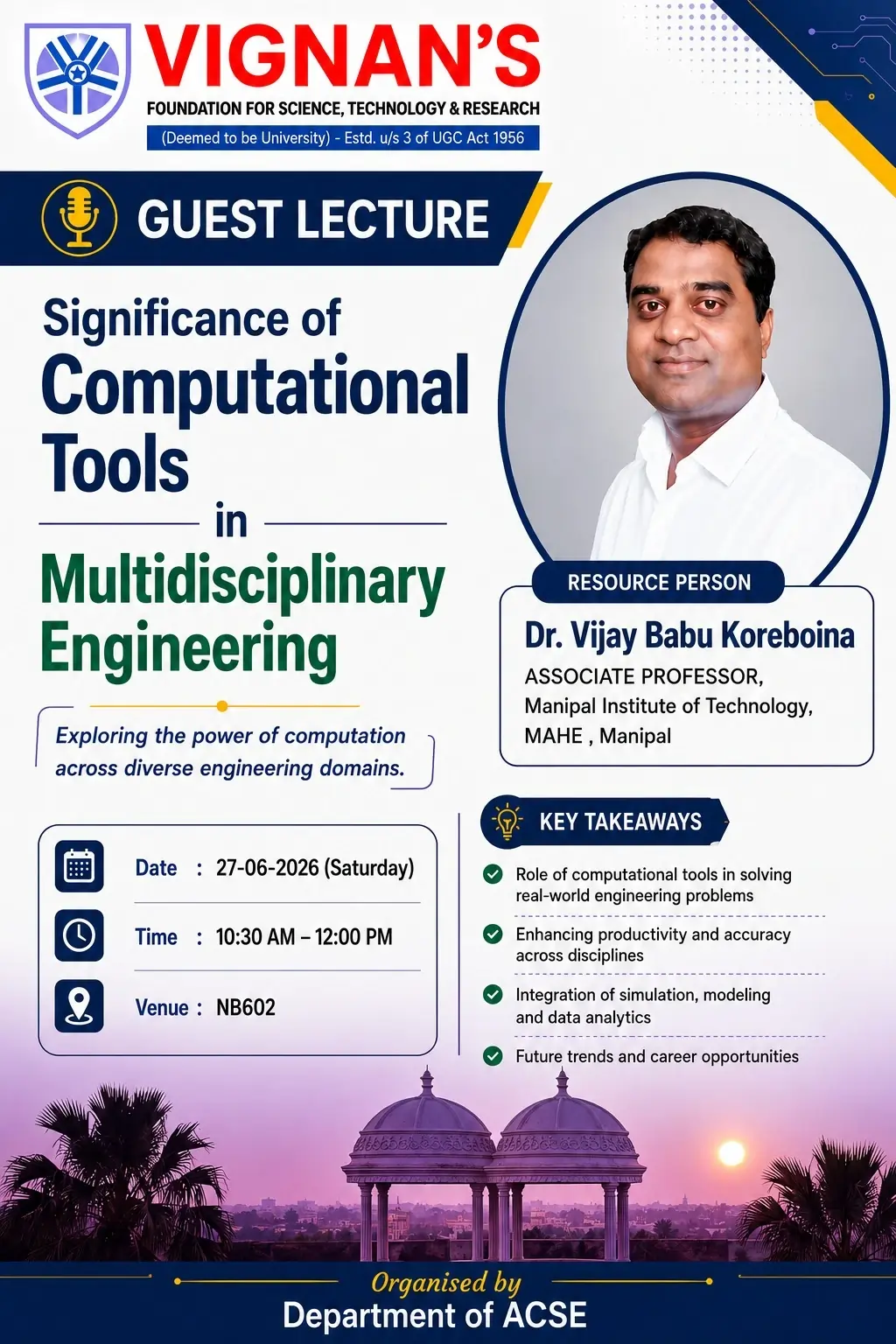
Guest Lecture
Significance Of Computational Tools in Multidisciplinary Engineering
Jun
27
Saturday
10:00
AM
- 12:30
PM
Summary
One of the most significant contributions of computational tools is their ability to perform complex numerical calculations that would otherwise require enormous manual effort. Advanced mathematical software packages solve systems of linear and nonlinear equations, perform optimization, evaluate differential equations, and conduct statistical analyses with remarkable precision. Numerical techniques such as the Finite Element Method (FEM), Finite Difference Method (FDM), Finite Volume Method (FVM), and Boundary Element Method (BEM) enable engineers to simulate physical phenomena under various operating conditions. These techniques provide valuable insights into stress distribution, heat transfer, fluid flow, vibration analysis, electromagnetic field behavior, and structural stability. Engineers can evaluate multiple design alternatives quickly and identify optimal solutions without constructing expensive physical prototypes. Computer-Aided Design (CAD) has revolutionized engineering design by enabling precise three-dimensional modeling of products and systems. Engineers can create detailed geometric models, visualize complex assemblies, detect design errors, and modify designs efficiently before manufacturing. CAD software supports collaborative engineering by allowing multiple designers from different disciplines to work simultaneously on the same project. Integration with Computer-Aided Engineering (CAE) and Computer-Aided Manufacturing (CAM) creates a seamless digital workflow from conceptual design to production. This integrated approach improves productivity, reduces design iterations, and enhances communication among multidisciplinary teams.
Read More
About Guest Lecture
Computational tools have become an indispensable part of modern multidisciplinary engineering, enabling engineers and researchers to solve complex problems with greater accuracy, speed, and efficiency. As engineering disciplines continue to evolve and intersect, traditional manual methods are no longer sufficient to address the increasing complexity of real-world challenges. Computational tools integrate mathematical models, numerical methods, simulation techniques, data analytics, artificial intelligence, and visualization technologies to assist engineers in designing, analyzing, optimizing, and validating engineering systems. These tools reduce development time, minimize costs, improve product quality, and support innovation across diverse engineering fields such as mechanical, civil, electrical, electronics, chemical, aerospace, biomedical, environmental, and computer engineering. By allowing engineers to model complex systems before physical implementation, computational tools significantly reduce risks associated with design failures and experimental uncertainties.

Read More
Venue
ACSE Department_Room No-602_ 6th Floor_N-Block
Dept.of Advanced Computer Science and Engineering
About Speakers
Dr.Vijay Babu Koreboina
Assosiate Professor, Manipal Institute of Technology, MAHE, Manipal
Event Coordinator
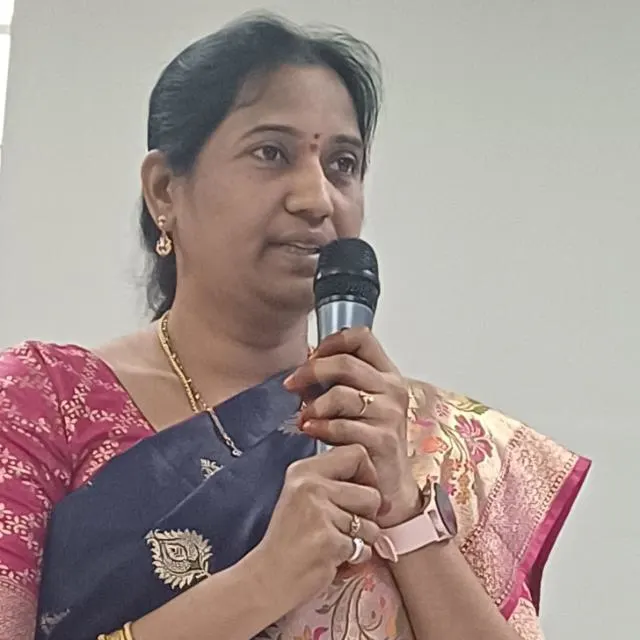
Dr.B.Jyostna Devi
Assosiate Professor, AIML HoD
Contact Us
Vignan's Foundation for Science, Technology and Research
(Deemed to be University), Vadlamudi, Guntur-522213
info@vignan.ac.in
0863-2344700 / 701
Be The First to Know.
Copyrights © 2026 Vignan University. All rights reserved.