


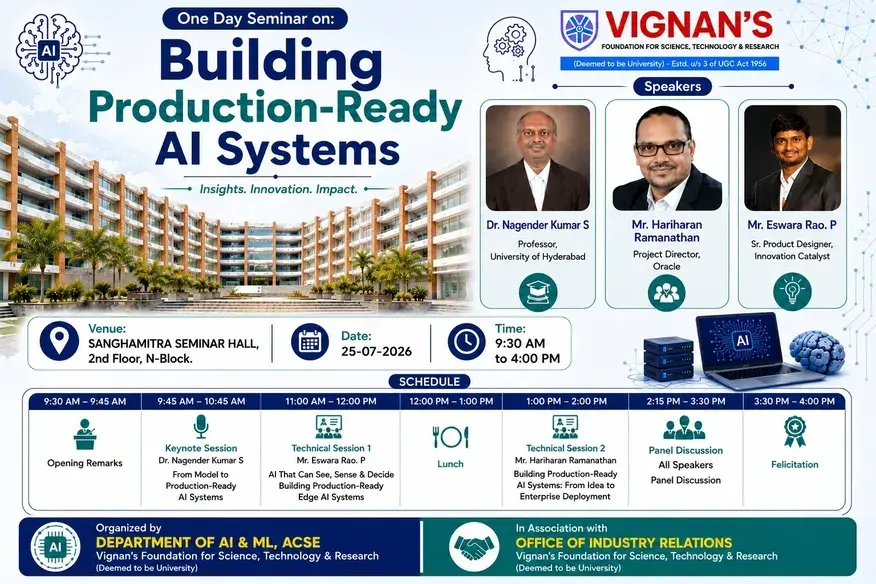




Title Page
విజ్ఞాన శాస్త్ర సాంకేతిక పరిశోధనా సంస్థ / विज्ञान शास्त्र प्रौद्योगिकी और परिशोधन संगठन
Events
Seminar
Building Production-Ready AI Systems
Jul
25
Saturday
09:30
AM
- 04:00
PM
Summary
1. What is a Production-Ready AI System? A production-ready AI system is an AI application that is: Reliable and consistently available Scalable to handle increasing workloads Secure and compliant with regulations Easy to maintain and update Continuously monitored for performance Unlike prototype models, production AI systems operate in real-world conditions where data changes over time and users expect fast, accurate responses. 2. AI Development Lifecycle The lifecycle of a production AI system includes: Problem Definition Data Collection Data Cleaning and Preparation Feature Engineering Model Training Model Evaluation Deployment Monitoring Continuous Improvement Each stage plays a critical role in ensuring long-term system performance. 3. Data Management Data is the foundation of every AI system. Important practices include: Collecting high-quality data Removing duplicate and incorrect records Handling missing values Data versioning Data governance and privacy Poor-quality data leads to inaccurate predictions regardless of how advanced the AI model is. 4. Model Development During development, engineers: Select suitable machine learning algorithms Train models using historical data Tune hyperparameters Validate using test datasets Common frameworks include: TensorFlow PyTorch Scikit-learn The goal is to build models that generalize well to unseen data. 5. Model Deployment After training, models must be deployed so users can access them. Common deployment methods: REST APIs Cloud platforms Docker containers Kubernetes clusters Edge devices Deployment should ensure Low latency High availability Easy updates
Read More
About Seminar
The Building Production-Ready AI Systems event focused on the practical aspects of designing, deploying, and maintaining AI applications that are reliable, scalable, and secure in real-world environments. Rather than concentrating only on model development, the event emphasized the complete AI lifecycle—from data preparation to deployment, monitoring, and continuous improvement. Key Highlights AI System Architecture: Best practices for building modular, scalable, and maintainable AI applications. Data Management: Strategies for collecting, cleaning, versioning, and governing data to ensure high-quality model performance. Model Deployment: Techniques for deploying AI models using cloud platforms, APIs, containers, and orchestration tools. MLOps: Importance of automated pipelines for training, testing, deployment, monitoring, and retraining models. Performance Monitoring: Methods to detect model drift, measure accuracy, monitor latency, and optimize resource usage. Security and Responsible AI: Approaches to protecting AI systems from threats, safeguarding user data, reducing bias, and ensuring compliance with regulations. Scalability and Reliability: Techniques such as load balancing, distributed inference, caching, and fault tolerance to support production workloads. Real-World Case Studies: Examples of successful AI deployments, lessons learned from failures, and industry best practices.

Read More
Venue
Sangamithra Seminal Hall, N-block, 2nd Floor
Dept.of Advanced Computer Science and Engineering
About Speakers
Dr. Nagender Kumar S Professor,
University of Hydarabad
Mr. Hariharan Ramanathan,
Project Director, Oracle
Mr. Eswara Rao P
Sr.Product Designer, Innovation Catalyst
Event Coordinator
Dr.Bodapati Jyostna Devi
AIML HoD, Associate Professor
Contact Us
Vignan's Foundation for Science, Technology and Research
(Deemed to be University), Vadlamudi, Guntur-522213
info@vignan.ac.in
0863-2344700 / 701
Be The First to Know.
Copyrights © 2026 Vignan University. All rights reserved.